
Discover how considerate behaviour makes the world go round.
Manners can seem like nothing more than a set of tedious rules to follow. They’re often something that parents and other adults try to instil in children, but with age and increased freedom, it’s tempting to let them slide. Does it really matter if you remember your pleases and thank-yous, or if you put your feet up on the train seat opposite you?
OPENING DOORS
Looking at the wider world, it might seem that there are many more important things to worry about than being polite. According to writers Kay Plunkett-Hogge and Debora Robertson, co-authors of Manners: A Modern Field Guide, manners are a form of ‘codified kindness’. They believe that knowing the best way to behave in common scenarios ‘enhances the quality of everyday life and that of people around you’.
Learning the code of manners is a way to communicate goodwill to others, making it a great tool for starting friendships. Manners are also useful for developing constructive relationships with everyone, from teachers and friends’ parents to people you might interact with only briefly. Kay says: ‘I’ve always worked under the assumption that manners are acts of kindness directed at strangers so that they will be nice in return.
KINDNESS IS FREE
Manners are important for making positive first impressions, and, as the saying goes, they cost nothing. They’re also a way of showing appreciation and consideration to our nearest and dearest. Offering to help with the washing-up or complimenting a family member for cooking a delicious meal are simple courtesies that are always welcome.
Being polite can be as easy as remembering to say ‘please’ and ‘thank you’ when you ask for or are offered something. These may seem like small, inconsequential words, but they never go out of style. Equally, it’s also completely natural to forget your manners from time to time, so read on for tips on remembering them.
Cues for kind conduct
It’s easy to be so preoccupied with the distractions of day-to-day life that common courtesy gets forgotten. Here’s how to show you care by remembering your manners in five different situations:
1. On public transport
Travelling is the perfect chance to catch up with texts, posts, and Toks, or to lose yourself in your favourite book, but it can be worth glancing around from time to time. Is there someone who needs your seat more? Is there an older person who needs help getting off the bus? Are your feet or your bag taking up a space someone else could use? Modern manners can be as simple as engaging with the world around you. It may not seem that important when surrounded by strangers, but you might make someone’s day, and the friendly smile of gratitude you get in return could brighten up your day, too.
2. At a new friend’s house
Sharing a meal with a friend’s family is when table manners come into their own. Every home does things differently, so it’s useful to have some universal rules to follow so you can feel confident that you’re not offending anyone. You don’t have to be at a formal dinner to show consideration, so you might make sure you leave enough for others if you’re offered seconds, think about keeping your mouth closed when you chew, or waiting until you’ve finished your mouthful before speaking. If your friend usually sets the table before the meal, then help out or offer to clear the plates afterwards.
3. When the phone beckons
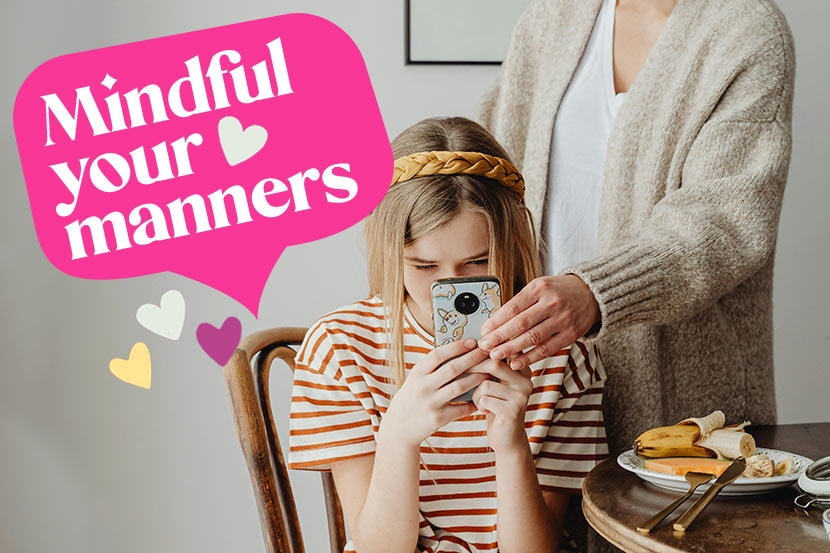
It might be tempting to reach for your phone during a lull in conversation or because you’re itching to know if someone’s replied to your Story. And if whoever you’re with is on their phone, why not pick up yours? But nothing says ‘I’ve got better things to do’ like focusing on your device when you’re spending time with friends. Not giving in to this temptation shows that you value the time you have with the person in front of you, enriches the quality of the conversation, and might even prompt your pals to put their phones away.
4. When you start a new school or job
Meeting a new adult is sometimes daunting, especially in formal settings. Knowing how to be polite can help ease nerves. Making eye contact and sitting upright shows interest whereas slouching gives the impression of boredom. Don’t be afraid to ask questions or speak up if there’s something you don’t understand.
Having good manners doesn’t mean knowing everything, it’s about being friendly and showing willingness to listen and learn.
5. When you forget
Don’t worry if you forget the code occasionally. No one is perfectly polite all the time. The main points to remember are to express gratitude when someone does something for you – even if you’re a bit late in doing so – and treat others with kindness and respect. These principles help to make a good impression in all kinds of life situations so that, instead of feeling like boring restrictions, manners become the key to new adventures.
Words by: Kate Orson