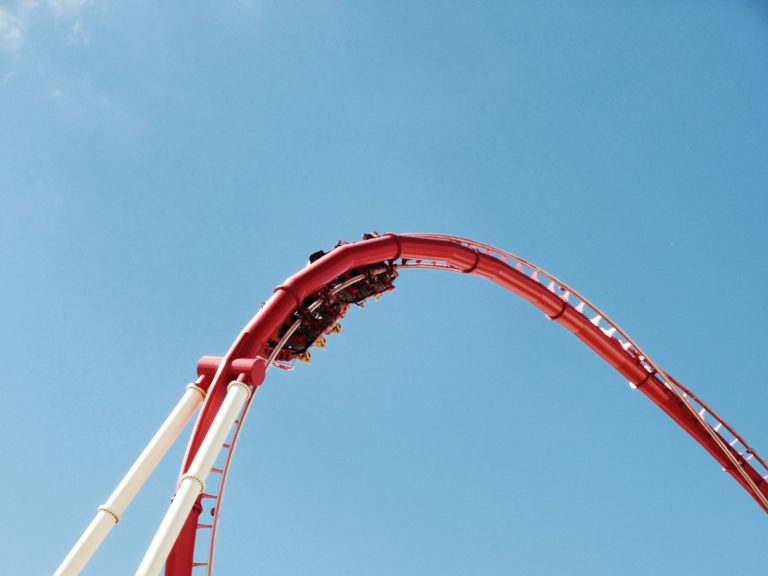


Some people have a head for heights, while others are filled with fear at the thought of being above ground level. Here's how to calm your nerves and learn to love the high life.
You’re behind the glass of a high-rise building, far above the ground. The horizon is bright and clear, and the trees and cars and people below appear as teeny-tiny specks. How do you feel? Is your heart soaring or hammering in your chest? Heights are complicated. The thought of standing close to a steep ledge or abseiling down a cliff face will turn some people’s knees to jelly but send a shiver of excitement down the spines of others. And, of course, some people have no cares either way.
IN SEARCH OF ADVENTURE
Thrill seekers reaching for opportunities to leave the ground behind often love the spike of adrenaline that comes with being at a great height. From clambering up trees to scaling mountain summits, many climbers have a deep desire for vertical ventures that give them a great view of the landscape below. They love the perseverance it takes to make it all the way to the pinnacle and the sense of achievement that comes at the top of their ascent.
CLIMBING HIGH
Since sport climbing made its debut in the 2020 Olympic Games (which were postponed until 2021), interest in the sport has soared. And indoor climbing and bouldering gyms have answered the call for adventures close to home. It’s an ideal low-impact, low(ish)-risk sport, with plenty of physical and mental health benefits. It also gives that feeling of escaping the everyday. It improves flexibility, coordination, and problem-solving skills, while boosting all those feel-good hormones and offers a chance to become part of a community.
When new climbers are confident that they’re proficient enough, they can begin to think about one day ascending some of the world’s most beautiful hills and mountains.
ON EDGE
But while many people are keen to clip on a carabiner (a D-shaped metal ring that holds a rope), others can’t imagine anything worse. This condition is called acrophobia and is defined as an extreme or irrational fear of heights. A common symptom of this phobia is vertigo – a feeling that you, or the space around you, is moving when you look down from a height. A study published in
New Scientist magazine found that vertigo can impact the way you perceive distance. Researchers suggest that the stronger the fear, the larger the margin of error can be – so the scale of a drop seems far greater than it really is.
NATURE OR NURTURE?
There are two main theories about how a fear of heights develops – one proposes that it’s there from birth, the other suggests that it’s something people learn. The view of most evolutionary psychologists is that humans are born with an instinctive fear of heights, which helps protect them from potentially dangerous situations. Behavioural psychologists take a different view – that a fear of heights stems from learned experience. For example, if someone climbs a tree and falls from the branches, they’ll naturally be wary of repeating this in the future. And if parents or guardians are scared of heights, children are more likely to avoid them, too.
RISING ABOVE IT
As with all fears, there are ways to manage acrophobia. A study by the Frontiers in Psychology journal proved that breathing practices can be used to reduce stress and anxiety. Other research suggests that cognitive behavioural therapy is a good way to restructure or reframe the negative thoughts that come with these fears.’
STEP BY STEP
Many people find exposure therapy helpful. This involves people slowly working their way up to face ever-increasing heights. Some experts even use virtual reality (VR) to minimise anxiety. An immersive VR experience can simulate being high up and uses computer software that gives the option to step back if things feel overwhelming. If you’re struggling to overcome acrophobia, it’s worth talking to a healthcare professional for some more support. But if you’re keen to scale those dizzying heights, stay safe and keep moving on up.
ON TOP OF THE WORLD
Five ways to aim high.
1. SOAK IN THE VIEWS ON A SCENIC HIKE OR CYCLE
Fill your free time with fresh air and views on mountain trails, coastal paths, or hilly bushwalks.
2. SET OFF ON A HIGH-ROPES ADVENTURE
Take to the trees and test your Tarzan skills on an exploration of the canopy with an adventure-company experience.
3. SEEK OUT THE WORLD’S HIGHEST PLACES
Wherever you’re going, seek out the tallest building or attraction. You don’t have to take on Mount Everest – it could just be the Sky Point Observation Deck atop the Q1 building in Surfers Paradise.
4. TAKE A DEEP DIVE
Sometimes, the best part of being up high is the rush you get from coming back down to earth. In Australia, you have to be 16 to try tandem skydiving, but indoor skydiving simulators allow children as young as three to take part.
5. BUILD EACH OTHER UP
No matter what you do to get off the ground, having a friend beside you can take the adventure to even greater heights when you support each other.
This story was originally published in Teen Breathe Issue 34 (page 58) with the title: On top of the world